Category: Uncategorized

  • Tissue vs. Airlaid: What Custom Cocktail Napkins Are Really Made Of

    Tissue vs. Airlaid: What Custom Cocktail Napkins Are Really Made Of

    Two cocktail napkins can look identical folded on a tray and behave nothing alike the moment a wet glass lands on one. The difference is the paper. Custom cocktail napkins get chosen on print and color far more often than on material, yet the material is what decides whether the napkin absorbs the condensation, holds its fold, and feels like something a guest notices in a good way. The folded cocktail size is small, usually about five inches square, so there is not much napkin to work with, which makes the choice of stock matter even more. This is a look under the surface at what these napkins are actually made of.

    Tissue and airlaid: two different ways to make a napkin

    Almost every custom cocktail napkin is one of two materials. Tissue is the familiar one, thin plies of paper embossed and pressed together along the edges into the light, disposable napkin you see at most bars. Airlaid is the newer, premium option, made by dispersing cellulose fibers with air onto a belt and bonding them with heat, pressure, and a binder into a single dense sheet. The result feels soft and textile-like, closer to a linen napkin than to paper, and it behaves differently in the hand and against a drink. Once you know which family a napkin belongs to, most of its other properties follow.

    What ply actually buys you

    “Ply” simply means how many layers of tissue are pressed together. A one-ply beverage napkin is the lightweight bar standard, two-ply is the common event choice, and three-ply adds thickness and a more substantial feel in the hand. Each tissue ply is light on its own, on the order of eighteen to twenty grams per square meter, so with tissue, adding ply is how you add weight and perceived quality. Airlaid skips the stacking entirely: a single airlaid sheet often runs around forty to seventy grams per square meter by itself, which is why a one-ply airlaid can outweigh and outperform a three-ply tissue. When you spec a napkin, ply and material together set the weight and the feel, so decide both deliberately rather than just asking for something “thick.”
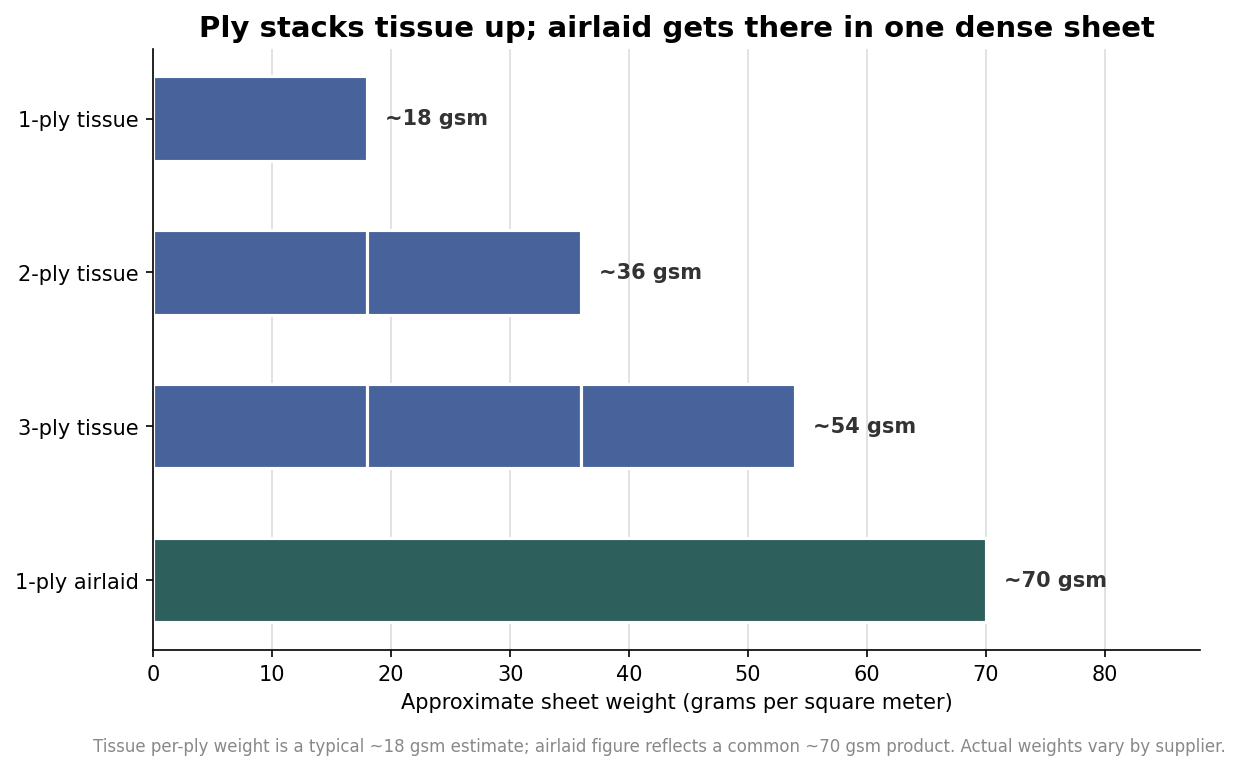
    Stacked horizontal bar chart showing tissue napkins gaining weight by stacking 18-gsm plies while a single airlaid sheet reaches about 70 gsm
    Tissue builds weight by stacking thin plies; one dense airlaid sheet outweighs a three-ply tissue napkin.

    Absorbency, wet strength, and the linen feel

    This is where airlaid earns its premium. Its bonded structure can absorb liquid up to roughly ten times its own weight without falling apart, and it stays strong when wet, where a thin tissue napkin quickly turns to pulp under a sweating glass. It also drapes and folds better, holding a crisp point on a passed tray and a clean line under a stemmed glass. Tissue is not trying to be linen; it is trying to be inexpensive and perfectly adequate for a quick drink, and for a busy bar that is exactly the right goal. The honest trade-off is simple: airlaid feels and performs closer to cloth but costs more, while tissue is lighter, cheaper, and completely fine for high-volume service where napkins are used once and tossed.
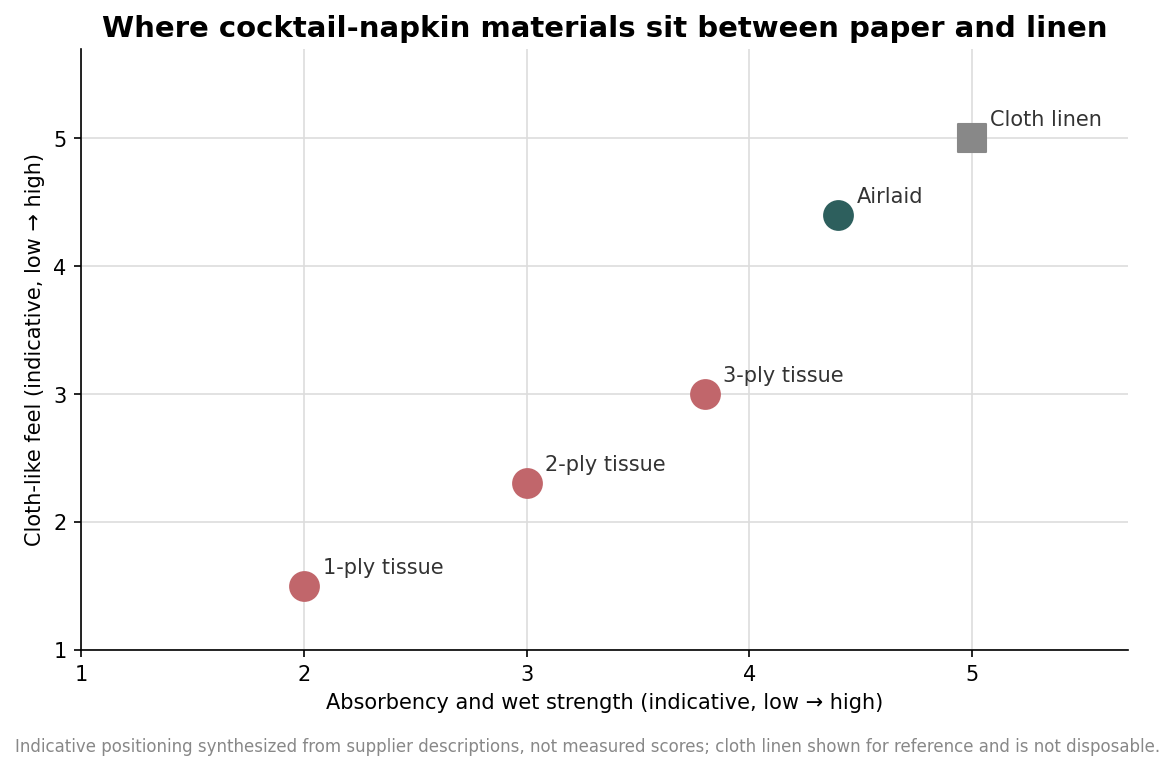
    Scatter plot positioning napkin materials by absorbency and cloth-like feel, from one-ply tissue up to cloth linen
    Airlaid sits closest to cloth linen on both feel and wet strength; tissue trades that for lower cost.

    How the paper changes what you can print

    Material is not only a feel; it decides what your artwork can do. Tissue takes flexographic and digital printing well for names, logos, and monograms in one or several colors, and it is the workhorse for large runs on a budget. Airlaid’s dense, even surface is what makes premium finishes shine. Embossing reads crisply because there is a solid sheet to press into, and foil stamping sits cleanly on the smoother, sturdier stock rather than crushing a fragile tissue. If your design leans on metallic foil or a deep emboss, the paper you choose matters as much as the printing method, and a beautiful foil monogram is one of the clearest reasons to pay for airlaid rather than tissue. It is also worth proofing a color on the actual stock, since the same ink can read differently on a soft tissue than on a dense airlaid surface.

    The sustainability spec: recycled, FSC, and compostable

    Buyers increasingly ask what the napkin is made of and where it goes after the party, and those answers are now part of the spec sheet. Recycled-content napkins use post-consumer fiber and are widely available in both plain and custom-printed cocktail sizes, including natural kraft looks. For virgin fiber, look for chain-of-custody certification such as FSC or PEFC, which tells you the pulp came from responsibly managed forests. Tree-free napkins made from bamboo are on the market as well and are frequently FSC-certified and compostable. Many tissue and airlaid napkins are biodegradable and can be composted alongside food waste, which suits a venue running a compost stream. If the napkins will touch food or a garnish, confirm they are intended for food contact, and where it matters to you, ask whether they are free of added PFAS. None of this changes how the napkin looks, but it changes what you can honestly tell a client or a guest.

    The practical move is to start from the event, not the SKU. A packed bar pushing hundreds of drinks an hour is a tissue job, and paying for airlaid there is money landing in the trash. A wedding cocktail hour, a milestone dinner, or a brand’s launch event is where airlaid’s cloth feel and clean foil earn their cost and end up in the photos. Match the paper to the moment, spec the material, ply, size, and finish deliberately, and the napkin will quietly do exactly what you needed without anyone having to think about it.
  • How Many Cocktail Napkins Do You Need? A Per-Guest Planning Guide

    How Many Cocktail Napkins Do You Need? A Per-Guest Planning Guide

    The single most useful number for a cocktail napkin order is somewhere between three and four per guest. It is also a number that hides almost everything that matters: where the napkins actually get used, how much an open bar changes the math, and the fact that a personalized print run stops being reorderable the moment you need more. This guide turns that loose rule of thumb into an order quantity you can defend, without ending the night either buried in leftovers or wiping hands on cocktail dresses.

    The per-guest rule of thumb, and why it is a range

    Most entertaining guides land on three to four cocktail napkins per guest for a drinks-and-appetizers event, and wedding planners commonly budget around three and a half per guest as a single blended figure. That spread exists because guests do not take one napkin and hold onto it. They grab a fresh one at the bar, another with a passed appetizer, one more at the dessert table, and abandon each of them about a quarter used. The lower end of the range fits a short, seated-heavy gathering; the upper end fits a long reception with a busy bar. Sit-down meals run on entirely different math, where you plan one to two luncheon or dinner napkins per guest, and more if the menu is genuinely messy.

    Build the number by station, not just by headcount

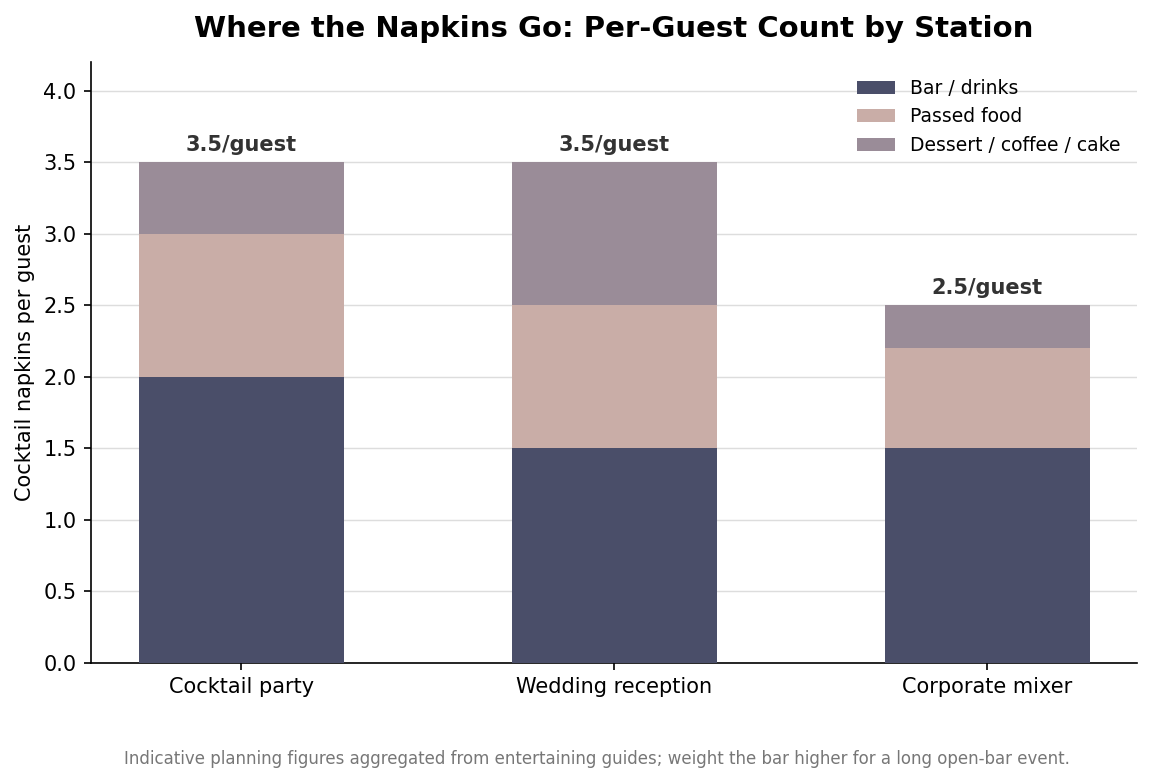
    A flat multiplier is fine for a first estimate, but it hides the fact that napkins cluster at stations rather than spreading evenly across the room. The bar is the biggest driver, because most drinks are handed over with a napkin already wrapped around the glass, and a signature-cocktail bar moves more than beer and wine. Passed or stationed food is the next block, roughly one per guest across an evening. Dessert, coffee, and cake add another wave late in the night. Restrooms are a separate line item entirely, usually planned as guest towels at about two per guest rather than from your cocktail count. Adding these up by station, instead of trusting one number, is what keeps a second bar or an extended cocktail hour from quietly blowing through your supply.

    Stacked bar chart of cocktail napkins per guest split by bar, food, and dessert stations across three event types
    Per-guest napkin counts broken out by station for three common event types.

    Adjust for length, bar style, and menu

    Event length is the multiplier people forget. A four-hour reception moves far more napkins than a ninety-minute mixer with the same headcount, simply because guests return to the bar more times. Bar style matters too: an open bar with signature cocktails and garnishes drives more napkins than a limited beer-and-wine service. Then there is the food. Hand-held or messy items such as sliders, wings, barbecue, or anything with a dipping sauce push you to the top of the range and sometimes past it. Outdoor and warm-weather events add another quiet demand, because condensation on cold glasses means guests reach for a wipe they would not bother with indoors.

    Add overage, then round to the print run

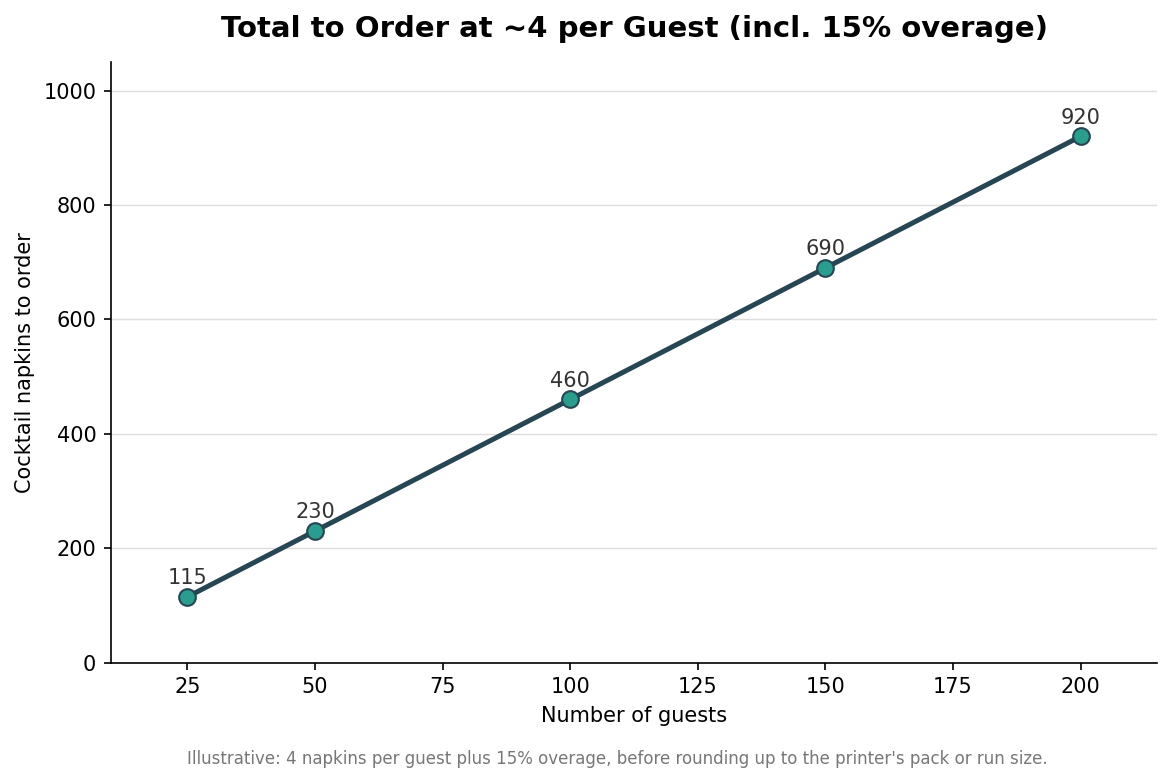
    Here is the part that separates napkins from most party supplies: personalized cocktail napkins are printed in set quantities and cannot be quietly topped up the week of the event. A rental shortfall you can fix with a phone call; a monogrammed print run you cannot. So build in roughly 10 to 15 percent overage on top of your per-guest total, both to cover spills and mid-refill gaps and because leftover personalized napkins are not wasted the way an over-ordered rental is. They store in a drawer and reappear at the next gathering. Then round up to the pack size or print-run count the vendor actually sells. Ordering slightly over is nearly free next to the cost of a rush reorder, or the look of an empty bar tray at ten at night.

    Line chart of total cocktail napkins to order versus guest count at four per guest plus fifteen percent overage
    Total napkins to order as guest count rises, at roughly four per guest with overage.

    A worked example

    Take a 150-guest wedding with a four-hour reception and an open bar. Start at the upper end of the range, four per guest, which puts you at 600 napkins. Add 15 percent overage and you are near 690. Round up to the nearest print run, often 700 or 750, and you have a number you can defend, with a small cushion that lives in a cupboard rather than a landfill. Run the same logic for a 60-guest backyard cocktail party at three per guest and you are near 210, rounding comfortably to 250. In both cases the order that goes wrong is almost never the one with a few too many napkins.

    Size and ply change how many feel like enough

    Quantity also interacts with the napkin itself. A cocktail or beverage napkin is typically around five inches square folded and roughly ten inches open, and it comes in one, two, or three ply. A thin single-ply napkin gets used up and swapped out faster, so guests reach for more of them across a night, while a sturdier two- or three-ply napkin does more work per sheet and can shave the top off your per-guest count. Ply matters for the printing, too: a heavier napkin holds a foil stamp or a dark flood color better and resists the pilling that makes a napkin look spent after a single wipe. None of this moves the three-to-four starting point dramatically, but it is often what decides whether the same crowd sits at the low end or the high end of the range.

    Put it together

    Start from three to four per guest, break that total across the bar, the food, and the dessert stations so a second bar does not surprise you, and adjust up for a long event, a busy open bar, or a messy menu. Add 10 to 15 percent overage, then round up to the pack or print-run size before you submit artwork. Every figure here is indicative rather than exact, so confirm the actual pack count and any print minimums with your printer, lock the design, and order once. The leftovers are a drawer problem. Running out is a party problem.

  • How to Spec a Custom Cocktail Napkin Order: Size, Ply, and Quantity

    How to Spec a Custom Cocktail Napkin Order: Size, Ply, and Quantity

    Ordering custom cocktail napkins sounds like it should take five minutes, and then you open a product page and get asked for a size, a ply, a fold, a quantity, a print method, and a number of ink colors before you can add anything to a cart. Most of those choices are easier than they look once you know what each one actually controls. This walkthrough goes through the spec sheet in the order that matters, so the napkin you receive matches the one in your head.

    The short version: pick the size for the job, choose a ply for how the napkin should feel in the hand, work out quantity from your guest count rather than guessing, and only then decide between ink and foil. Getting the first three right is what keeps you from either running out at the bar or storing three unopened boxes in a closet for the next two years.

    Start with the size, because it changes everything else

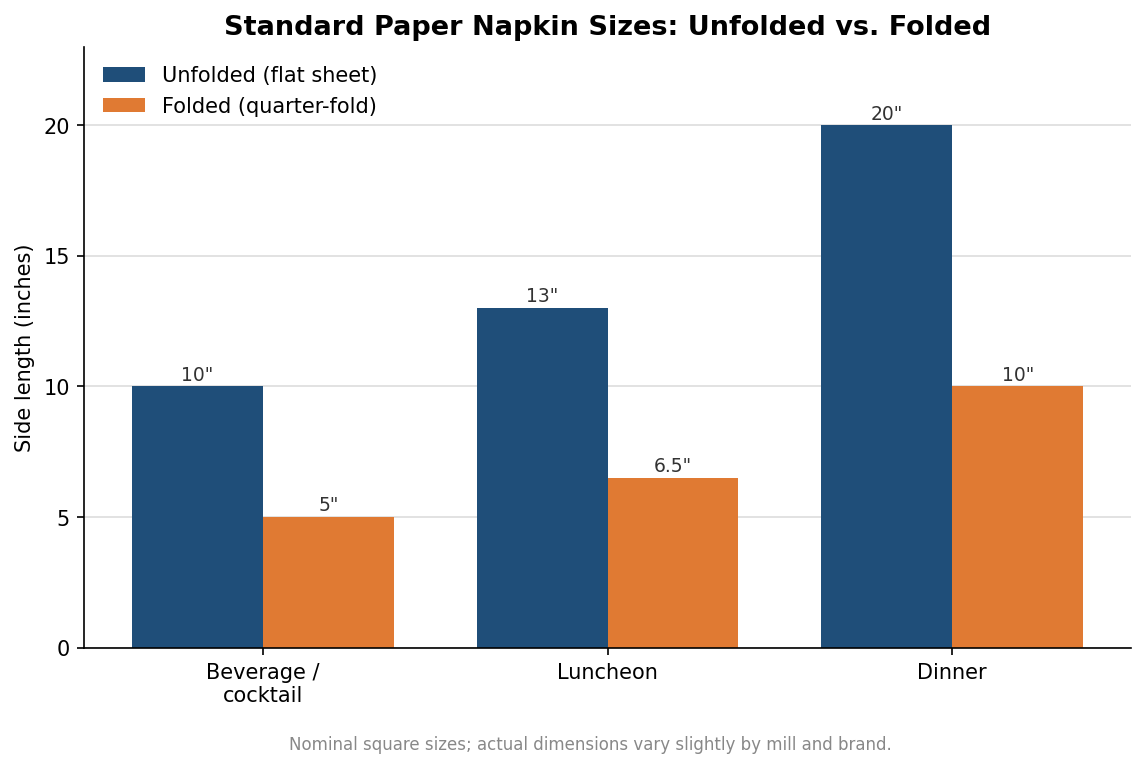
    Paper napkins come in a small number of standard sizes, and the names are more consistent than they seem. A beverage napkin, which is what most people mean when they say cocktail napkin, is a 10-inch square that arrives quarter-folded down to a 5-inch square. That folded 5-by-5 footprint is the one that sits under a drink or gets stacked on a bar, so it is the number worth picturing. A luncheon napkin steps up to 13 inches unfolded and about 6.5 inches folded, and a dinner napkin is a 20-inch sheet that folds to a 10-inch square. Actual dimensions drift a little between mills, so treat these as nominal rather than exact.

    Grouped bar chart comparing unfolded and folded dimensions of beverage, luncheon, and dinner napkins
    Beverage (cocktail) napkins are a 10-inch square that folds to 5 by 5 inches; luncheon and dinner sizes step up from there.

    The reason size comes first is that it drives everything downstream. A 5-by-5 folded napkin gives your artwork a printable area that is smaller than a coaster, which is why busy logos with fine text tend to disappear on a cocktail napkin and read fine on a luncheon size. If your design has a lot going on, the honest fix is often to go up a size rather than to shrink the art. If it is a clean monogram or a short line of type, the beverage size is the classic choice and the most economical one.

    Ply is the feel, and it is also the cost

    Ply is the number of tissue layers bonded together, and it is the single biggest lever on how a napkin feels. One-ply is thin and best suited to high-volume, low-cost situations where the napkin is grabbed by the handful. Two-ply is the everyday middle, soft enough to feel intentional and sturdy enough to wrap a sweating glass without falling apart. Three-ply is the premium tier, noticeably thicker and more absorbent, and it is what you want when the napkin is part of the impression, at a wedding, a launch party, or a hotel bar. As a rule, each step up in ply costs more per napkin and absorbs more condensation, which in practice means guests take fewer of them.

    There is a quality point hiding in that last sentence. A cheaper one-ply napkin can end up costing more for an event because people grab two or three at a time to get the absorbency they expected. If you are choosing between a thinner napkin at a lower unit price and a thicker one that costs a bit more, estimate the real spend at the ply you would actually use, not just the sticker price per thousand.

    Quantity: plan from guests, not from a round number

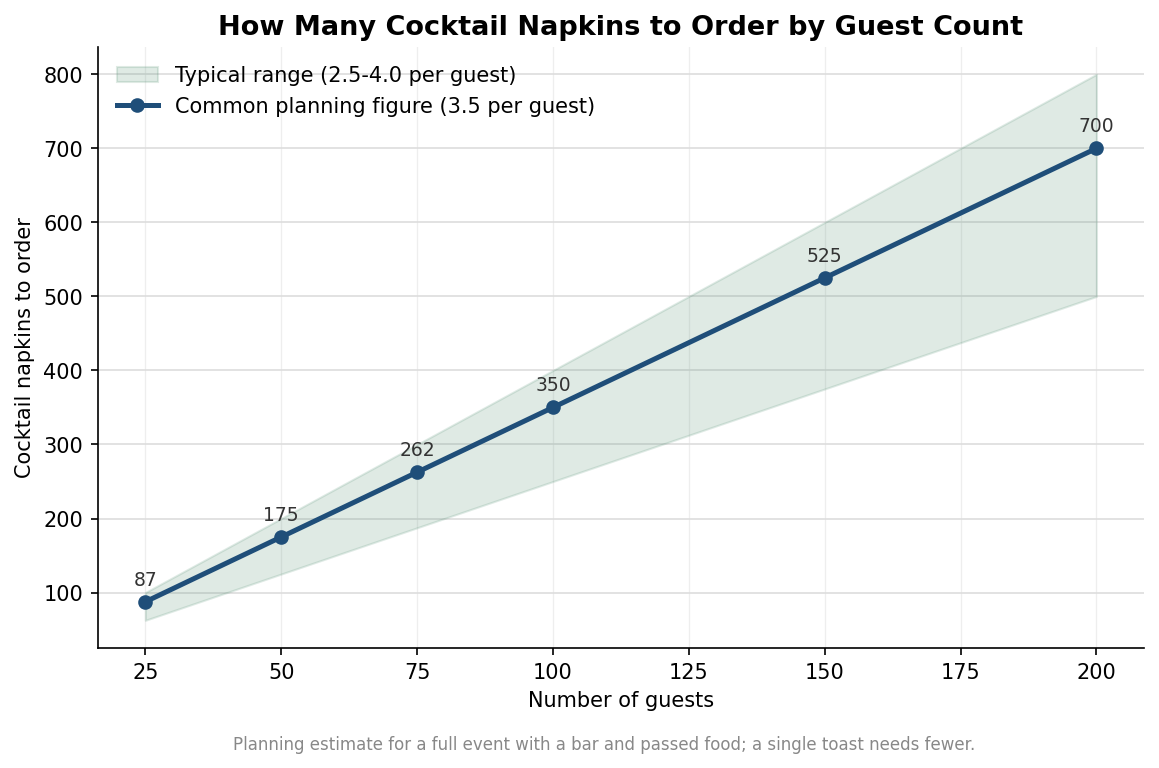
    The most common ordering mistake is buying a tidy round number like 100 or 500 because it feels like enough. Napkins get used at a rate most people underestimate. A widely used planning figure for a full event with a bar and passed food is about 3.5 cocktail napkins per guest, which accounts for drinks being refreshed, food being handed around, and napkins landing on coffee, dessert, and specialty stations. A lighter event, say a single toast or a short reception, runs closer to two to three per guest, while a long evening with an open bar can push past four.

    Line chart showing cocktail napkins to order versus guest count at 3.5 per guest with a 2.5 to 4.0 range band
    At about 3.5 napkins per guest, a 100-person event needs roughly 350 napkins; the shaded band shows the typical planning range.

    Run your own number before you order. A 100-guest reception at 3.5 per guest is 350 napkins, so a single box of 250 is short and two boxes is comfortable with a small reserve. Ordering slightly over is the safer error here, because custom napkins are printed to order and you cannot top up on the day. A modest overage also covers the napkins that get set down half-used, which is a larger share than anyone expects. If your event has multiple stations, a coffee bar plus a cocktail bar plus a dessert table, lean toward the higher end of the range rather than the planning figure.

    Ink or foil, and how many colors

    Once size, ply, and quantity are settled, the print method is mostly an aesthetic and budget decision. Flat ink printing lays color directly onto the tissue and is the workhorse: it handles one or more spot colors, keeps the unit price down, and suits logos, names, dates, and short messages. Foil stamping presses a metallic film, most often gold, silver, or rose gold, and gives that reflective finish people associate with formal events. Foil looks the part but is the pricier option and works best with bold, simple artwork, because very fine lines and small type do not stamp cleanly.

    Color count matters because each additional ink color is usually a separate charge and, on some processes, a separate setup. A one-color logo on a napkin is not a compromise; it is the format working as intended. If your brand mark only holds together in full color with gradients, a napkin is not the surface that will reproduce it faithfully, and simplifying to a single-color version for this one item will look better than forcing the full artwork onto tissue.

    Putting the spec sheet together

    With those four decisions made, the rest of the order form is quick. A typical custom cocktail napkin order reads something like a 5-by-5 folded beverage napkin, two-ply or three-ply depending on the occasion, in a quantity set from your guest count at roughly 3.5 each, printed in one or two ink colors or a single foil. Standard turnaround at Customized Cocktail Napkins is about 2 weeks after you approve the mockup, with express turnaround available on request, so confirm the timeline against your event date before you finalize. The cost per napkin comes down as quantity rises, which is another reason to size the order to the event rather than buying the smallest pack twice.

    The thread running through all of this is that the physical choices, size, ply, and quantity, decide whether the napkin does its job, and the decorative choices, ink versus foil and color count, decide how it looks doing it. Settle the first three against the actual event and the napkin will feel right in the hand and there will be enough of them; treat the artwork as something to fit the surface rather than the other way around, and it will print cleanly at whatever size you land on.

  • Wedding Cocktail Napkins: What Actually Ends Up in the Photos

    Couples spend months on the invitation and about four minutes on the napkin, which is backwards: far more people photograph the napkin.

    What to print

    Two names and an ampersand, a monogram, or the date. That is the whole list that works. Longer phrases shrink the type until nothing reads at five inches, and a venue line is better on the sign than on the napkin.

    If you want one thing that guests remember, use the two names. If you want one thing that dates the photograph beautifully, use the date.

    Matching the invitation

    Send us a photo or PDF of the invitation and we match the typeface, spacing and color for free. The step that matters is the mockup: a delicate script that looks perfect on a 5×7 card can lose its hairlines at napkin size, and you want to discover that on screen rather than in the box.

    Ink or foil

    Ink carries the muted, dusty palettes most couples choose and is the safer answer for a script. Foil in gold or rose gold catches the light of the room and photographs beautifully, but it wants a simpler, more solid mark.

    Blush or ivory stock with rose gold foil is the most-ordered wedding combination we run.

    How many to order

    Plan on roughly two to three napkins per guest for cocktail hour alone — people take a fresh one with each drink and put the old one down. Ordering to guest count exactly is the single most common regret.

    Our minimum is 12, so ordering a small test batch first to see the print in your own hands costs almost nothing but a few days.

  • How Cocktail Napkins Are Printed: Flexo, Digital and Foil

    Every cocktail napkin quote comes down to one of three processes. Knowing which one your artwork needs saves both money and a disappointing carton.

    Flexographic printing

    Flexo presses one to three flat spot colors from a plate. It is fast, efficient at volume, and the right answer for a house design you reorder every quarter. Its limit is absolute: no gradients, no photographs, no blends. A color is either on the plate or it does not exist.

    If your logo is two flat colors, stop reading and order flexo.

    Full-color digital

    Digital printing has no color limit and no plate, so gradients, illustrations and photographs all reproduce, and short runs become viable because there is no setup to amortise. It also unlocks full-bleed, where the color runs to every edge instead of sitting in the middle of a white napkin.

    For a one-night activation with bespoke artwork, digital is almost always the correct choice.

    Hot foil stamping

    Foil is not printing at all — a heated die presses metallic film into the sheet. The mark reflects the room rather than absorbing it, which is why a foiled napkin reads as expensive across a dim bar.

    The die is the constraint and the cost. Foil rewards a solid, simple mark and a design you will reorder; it cannot do gradients at all.

    Picking in ten seconds

    Flat logo you reorder: flexo. Gradient, photo or one-night bespoke: digital. Solid mark, dark stock, premium room: foil. Still unsure? Ask for both on the mockup — it is free and it settles it.

  • Why Your Bar Napkin Should Probably Not Be White

    Almost every bar orders white napkins, and a good number of them should not. The reason is light.

    What a dark room does to a white napkin

    Bars are lit low and warm, usually with pendants over the pass and the bar top. A white napkin under that light is the brightest object on the counter: it glares, it pulls the eye away from the drink, and on a dark walnut or zinc bar top it reads as a stack of paper rather than part of the room.

    Meanwhile the logo, printed dark on white, has the least contrast it will ever have in exactly the conditions where you wanted it seen.

    What colored stock does instead

    Black, navy, forest and burgundy stock sit down into a dark bar top and let the drink be the bright thing. Printed in white ink or stamped in metallic foil, the mark reads clearly without shouting, and it photographs far better — which matters, because customers photograph drinks constantly.

    The white-ink caveat

    Printing white onto dark is a different process from dark onto white, and fine detail needs a little more stroke weight to hold. This is fixable and free: we adjust the artwork and show you the difference in the mockup rather than letting you find it in the carton.

    When white is right

    Bright rooms. Daytime cafes, hotel lobbies with tall windows, garden bars and anywhere the light is cool and plentiful. White stock in daylight looks clean; white stock at midnight looks like a napkin dispenser.

    The most-ordered combination

    Black stock with gold foil, by a distance. It is not fashion — it is the combination that survives low light and comes out well in a photograph.