Ordering custom cocktail napkins sounds like it should take five minutes, and then you open a product page and get asked for a size, a ply, a fold, a quantity, a print method, and a number of ink colors before you can add anything to a cart. Most of those choices are easier than they look once you know what each one actually controls. This walkthrough goes through the spec sheet in the order that matters, so the napkin you receive matches the one in your head.
The short version: pick the size for the job, choose a ply for how the napkin should feel in the hand, work out quantity from your guest count rather than guessing, and only then decide between ink and foil. Getting the first three right is what keeps you from either running out at the bar or storing three unopened boxes in a closet for the next two years.
Start with the size, because it changes everything else
Paper napkins come in a small number of standard sizes, and the names are more consistent than they seem. A beverage napkin, which is what most people mean when they say cocktail napkin, is a 10-inch square that arrives quarter-folded down to a 5-inch square. That folded 5-by-5 footprint is the one that sits under a drink or gets stacked on a bar, so it is the number worth picturing. A luncheon napkin steps up to 13 inches unfolded and about 6.5 inches folded, and a dinner napkin is a 20-inch sheet that folds to a 10-inch square. Actual dimensions drift a little between mills, so treat these as nominal rather than exact.
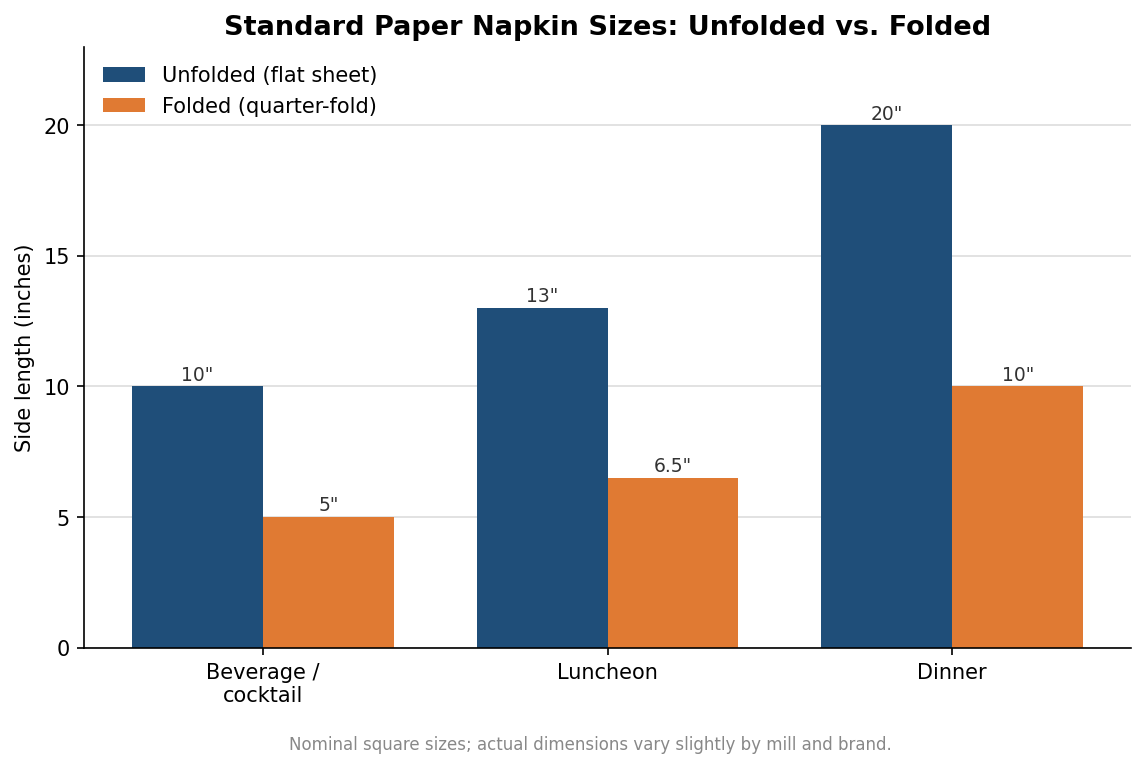
The reason size comes first is that it drives everything downstream. A 5-by-5 folded napkin gives your artwork a printable area that is smaller than a coaster, which is why busy logos with fine text tend to disappear on a cocktail napkin and read fine on a luncheon size. If your design has a lot going on, the honest fix is often to go up a size rather than to shrink the art. If it is a clean monogram or a short line of type, the beverage size is the classic choice and the most economical one.
Ply is the feel, and it is also the cost
Ply is the number of tissue layers bonded together, and it is the single biggest lever on how a napkin feels. One-ply is thin and best suited to high-volume, low-cost situations where the napkin is grabbed by the handful. Two-ply is the everyday middle, soft enough to feel intentional and sturdy enough to wrap a sweating glass without falling apart. Three-ply is the premium tier, noticeably thicker and more absorbent, and it is what you want when the napkin is part of the impression, at a wedding, a launch party, or a hotel bar. As a rule, each step up in ply costs more per napkin and absorbs more condensation, which in practice means guests take fewer of them.
There is a quality point hiding in that last sentence. A cheaper one-ply napkin can end up costing more for an event because people grab two or three at a time to get the absorbency they expected. If you are choosing between a thinner napkin at a lower unit price and a thicker one that costs a bit more, estimate the real spend at the ply you would actually use, not just the sticker price per thousand.
Quantity: plan from guests, not from a round number
The most common ordering mistake is buying a tidy round number like 100 or 500 because it feels like enough. Napkins get used at a rate most people underestimate. A widely used planning figure for a full event with a bar and passed food is about 3.5 cocktail napkins per guest, which accounts for drinks being refreshed, food being handed around, and napkins landing on coffee, dessert, and specialty stations. A lighter event, say a single toast or a short reception, runs closer to two to three per guest, while a long evening with an open bar can push past four.
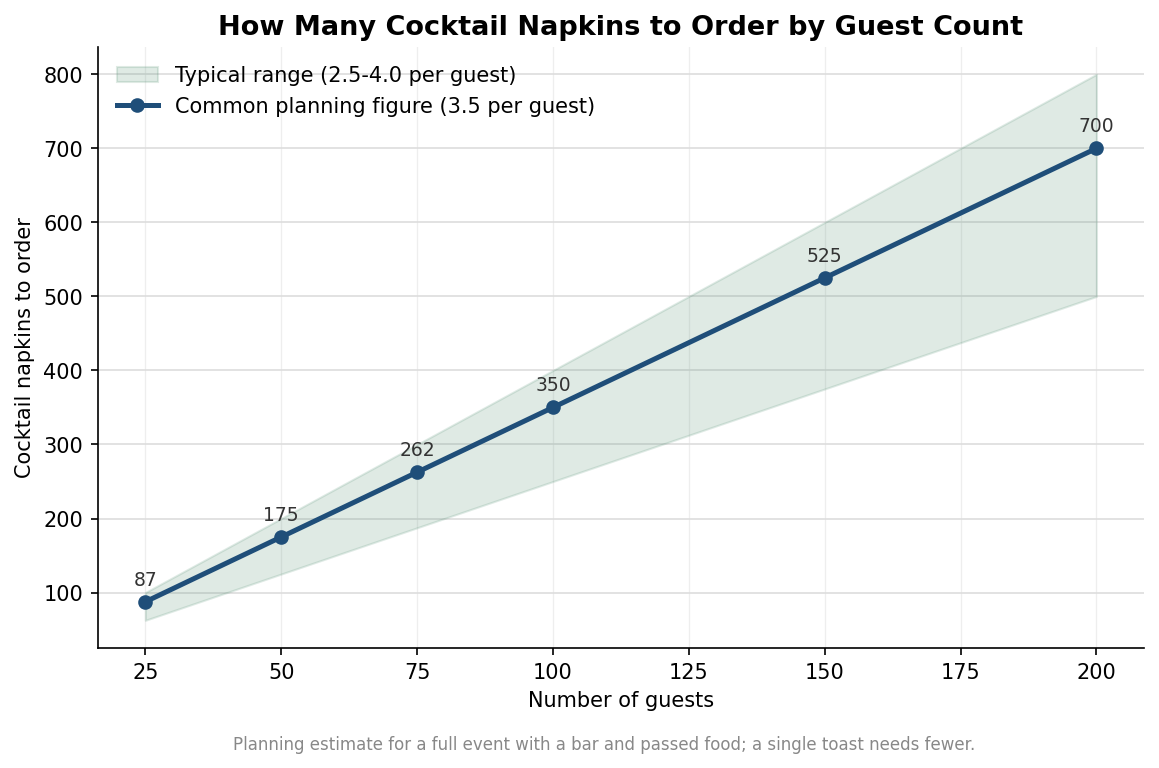
Run your own number before you order. A 100-guest reception at 3.5 per guest is 350 napkins, so a single box of 250 is short and two boxes is comfortable with a small reserve. Ordering slightly over is the safer error here, because custom napkins are printed to order and you cannot top up on the day. A modest overage also covers the napkins that get set down half-used, which is a larger share than anyone expects. If your event has multiple stations, a coffee bar plus a cocktail bar plus a dessert table, lean toward the higher end of the range rather than the planning figure.
Ink or foil, and how many colors
Once size, ply, and quantity are settled, the print method is mostly an aesthetic and budget decision. Flat ink printing lays color directly onto the tissue and is the workhorse: it handles one or more spot colors, keeps the unit price down, and suits logos, names, dates, and short messages. Foil stamping presses a metallic film, most often gold, silver, or rose gold, and gives that reflective finish people associate with formal events. Foil looks the part but is the pricier option and works best with bold, simple artwork, because very fine lines and small type do not stamp cleanly.
Color count matters because each additional ink color is usually a separate charge and, on some processes, a separate setup. A one-color logo on a napkin is not a compromise; it is the format working as intended. If your brand mark only holds together in full color with gradients, a napkin is not the surface that will reproduce it faithfully, and simplifying to a single-color version for this one item will look better than forcing the full artwork onto tissue.
Putting the spec sheet together
With those four decisions made, the rest of the order form is quick. A typical custom cocktail napkin order reads something like a 5-by-5 folded beverage napkin, two-ply or three-ply depending on the occasion, in a quantity set from your guest count at roughly 3.5 each, printed in one or two ink colors or a single foil. Standard turnaround at Customized Cocktail Napkins is about 2 weeks after you approve the mockup, with express turnaround available on request, so confirm the timeline against your event date before you finalize. The cost per napkin comes down as quantity rises, which is another reason to size the order to the event rather than buying the smallest pack twice.
The thread running through all of this is that the physical choices, size, ply, and quantity, decide whether the napkin does its job, and the decorative choices, ink versus foil and color count, decide how it looks doing it. Settle the first three against the actual event and the napkin will feel right in the hand and there will be enough of them; treat the artwork as something to fit the surface rather than the other way around, and it will print cleanly at whatever size you land on.