Two cocktail napkins can look identical folded on a tray and behave nothing alike the moment a wet glass lands on one. The difference is the paper. Custom cocktail napkins get chosen on print and color far more often than on material, yet the material is what decides whether the napkin absorbs the condensation, holds its fold, and feels like something a guest notices in a good way. The folded cocktail size is small, usually about five inches square, so there is not much napkin to work with, which makes the choice of stock matter even more. This is a look under the surface at what these napkins are actually made of.
Tissue and airlaid: two different ways to make a napkin
Almost every custom cocktail napkin is one of two materials. Tissue is the familiar one, thin plies of paper embossed and pressed together along the edges into the light, disposable napkin you see at most bars. Airlaid is the newer, premium option, made by dispersing cellulose fibers with air onto a belt and bonding them with heat, pressure, and a binder into a single dense sheet. The result feels soft and textile-like, closer to a linen napkin than to paper, and it behaves differently in the hand and against a drink. Once you know which family a napkin belongs to, most of its other properties follow.
What ply actually buys you
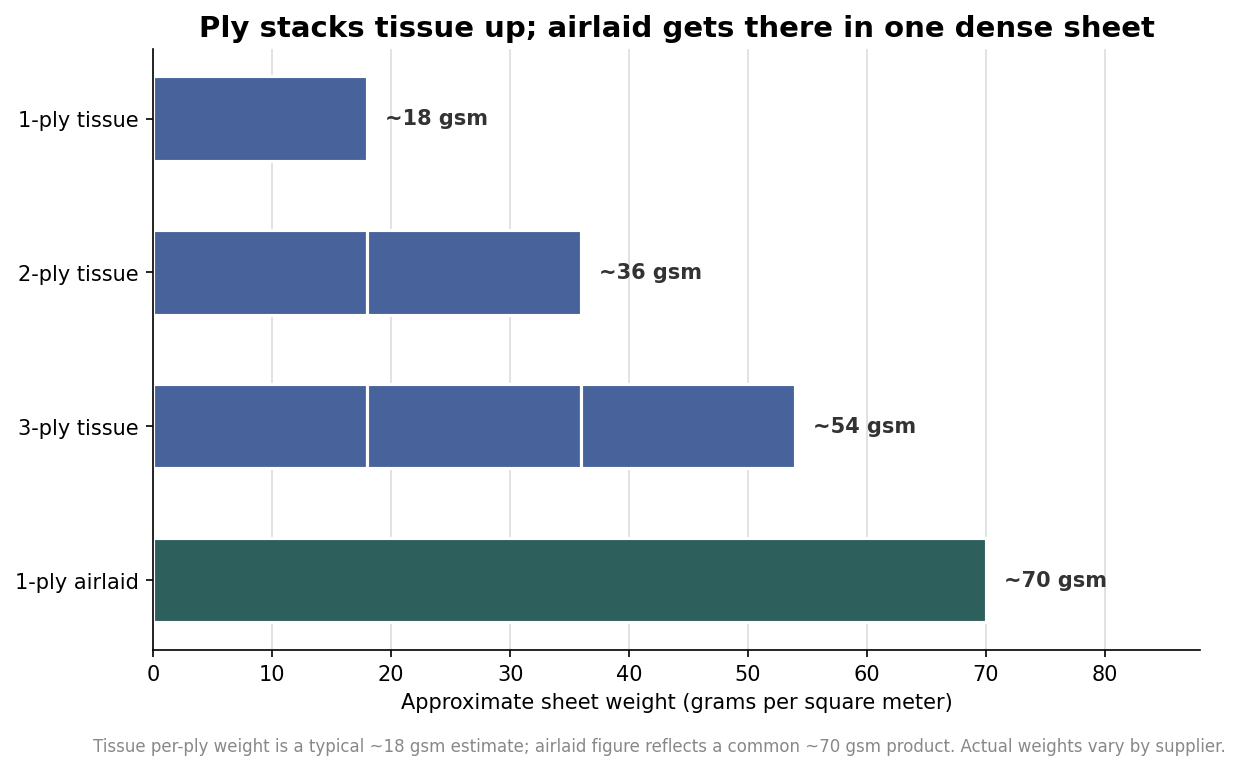
“Ply” simply means how many layers of tissue are pressed together. A one-ply beverage napkin is the lightweight bar standard, two-ply is the common event choice, and three-ply adds thickness and a more substantial feel in the hand. Each tissue ply is light on its own, on the order of eighteen to twenty grams per square meter, so with tissue, adding ply is how you add weight and perceived quality. Airlaid skips the stacking entirely: a single airlaid sheet often runs around forty to seventy grams per square meter by itself, which is why a one-ply airlaid can outweigh and outperform a three-ply tissue. When you spec a napkin, ply and material together set the weight and the feel, so decide both deliberately rather than just asking for something “thick.”
Absorbency, wet strength, and the linen feel
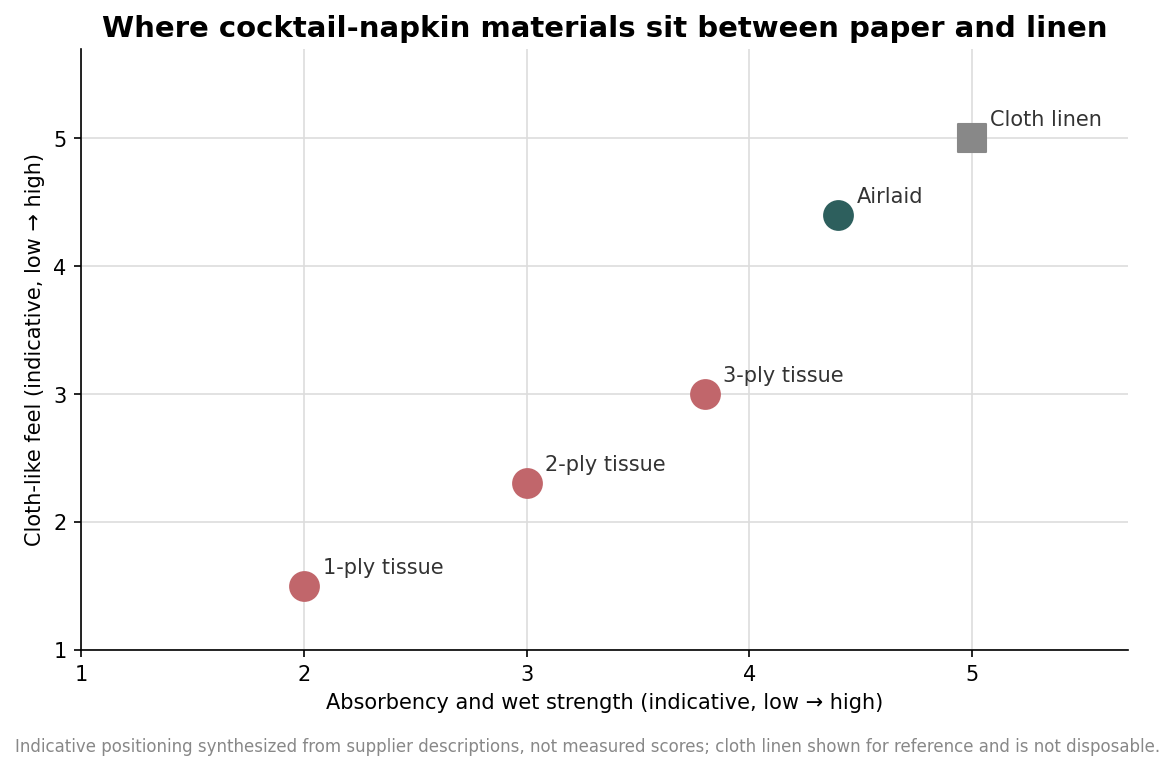
This is where airlaid earns its premium. Its bonded structure can absorb liquid up to roughly ten times its own weight without falling apart, and it stays strong when wet, where a thin tissue napkin quickly turns to pulp under a sweating glass. It also drapes and folds better, holding a crisp point on a passed tray and a clean line under a stemmed glass. Tissue is not trying to be linen; it is trying to be inexpensive and perfectly adequate for a quick drink, and for a busy bar that is exactly the right goal. The honest trade-off is simple: airlaid feels and performs closer to cloth but costs more, while tissue is lighter, cheaper, and completely fine for high-volume service where napkins are used once and tossed.
How the paper changes what you can print
Material is not only a feel; it decides what your artwork can do. Tissue takes flexographic and digital printing well for names, logos, and monograms in one or several colors, and it is the workhorse for large runs on a budget. Airlaid’s dense, even surface is what makes premium finishes shine. Embossing reads crisply because there is a solid sheet to press into, and foil stamping sits cleanly on the smoother, sturdier stock rather than crushing a fragile tissue. If your design leans on metallic foil or a deep emboss, the paper you choose matters as much as the printing method, and a beautiful foil monogram is one of the clearest reasons to pay for airlaid rather than tissue. It is also worth proofing a color on the actual stock, since the same ink can read differently on a soft tissue than on a dense airlaid surface.
The sustainability spec: recycled, FSC, and compostable
Buyers increasingly ask what the napkin is made of and where it goes after the party, and those answers are now part of the spec sheet. Recycled-content napkins use post-consumer fiber and are widely available in both plain and custom-printed cocktail sizes, including natural kraft looks. For virgin fiber, look for chain-of-custody certification such as FSC or PEFC, which tells you the pulp came from responsibly managed forests. Tree-free napkins made from bamboo are on the market as well and are frequently FSC-certified and compostable. Many tissue and airlaid napkins are biodegradable and can be composted alongside food waste, which suits a venue running a compost stream. If the napkins will touch food or a garnish, confirm they are intended for food contact, and where it matters to you, ask whether they are free of added PFAS. None of this changes how the napkin looks, but it changes what you can honestly tell a client or a guest.
The practical move is to start from the event, not the SKU. A packed bar pushing hundreds of drinks an hour is a tissue job, and paying for airlaid there is money landing in the trash. A wedding cocktail hour, a milestone dinner, or a brand’s launch event is where airlaid’s cloth feel and clean foil earn their cost and end up in the photos. Match the paper to the moment, spec the material, ply, size, and finish deliberately, and the napkin will quietly do exactly what you needed without anyone having to think about it.